
What is DevOps?
DevOps is an organizational and technical approach that more closely integrates software development (Development) and operations (Operations). The goal is to deploy software, configurations, and systems faster, more stable, and reproducible. DevOps is not a tool and not a framework, but rather a work and organizational model that combines processes, automation, and shared responsibility throughout the entire lifecycle.
1. Introduction
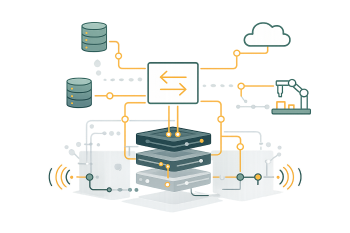
In modern industrial environments, the boundaries between traditional automation (OT) and information technology (IT) are blurring. While IT systems are already managed in a highly automated manner, manual handling still prevails in OT. DevOps closes this gap by establishing processes, tools, and a corresponding culture that enable continuous improvement of the system landscape. This is the foundation for a scalable Industry 4.0 infrastructure.
2. Why DevOps is Important
Manual management of industrial IT systems reaches its limits as complexity increases. Without DevOps methods, companies face concrete challenges:
- Error Susceptibility: Manual updates or configurations of middleware systems and gateways frequently lead to careless errors that can cause production downtime.
- Lack of Traceability: Without versioning, it is often unclear who made which change to an interface logic and when.
- Slow Release Cycle: New requirements, such as connecting a new ERP system or sensor, take too long because test phases are not automated.
- Silo Formation: Knowledge about system configurations is often tied to individual persons, which jeopardizes operations in the event of staff absences.
3. How DevOps Works
The core principle of DevOps is based on a closed loop of planning, development, build, test, release, deployment, operation, and monitoring.
CI/CD Pipelines
The technical foundation is formed by CI/CD pipelines (Continuous Integration / Continuous Delivery). Code or configurations are managed centrally in a repository (e.g., Git). As soon as a change is made, this automatically triggers tests. If these are successful, the change is automatically transferred to the target environment.
Declarative vs. Imperative Configuration
The imperative approach often dominates in OT: “Change value X in instance Y”. DevOps strives for a declarative model (Infrastructure as Code). Here, the target state is defined in a configuration file. The system independently ensures that the actual state corresponds to the target state.
4. Advantages of DevOps
The use of DevOps methods offers measurable technical advantages for industrial communication:
- Higher Release Frequency: Changes can be rolled out faster and safely in smaller steps.
- Automated Quality Assurance: Automated tests before deployment reduce the risk of logic errors in data communication.
- Fast Rollback: In the event of problems, a previous, functioning version of the configuration can be reverted to within seconds.
- Standardization: Identical configurations can be scaled to multiple locations or edge devices without issues.
5. Use Cases & Practice
DevOps finds application in industry where software and data flows are controlled:
- Industry: Management of software stacks on edge computers directly in manufacturing.
- IT/OT Integration: Automated deployment of mapping logics between OPC UA servers and SQL databases.
- Automation: Simulation of control logic in virtual environments (Digital Twin) before real deployment.
- Scenario: A global automotive supplier updates the communication logic of its assembly lines worldwide simultaneously via a central CI/CD pipeline instead of manually configuring each plant individually.
6. System Integration
In system integration, middleware such as the OPC Router serves as a bridge. DevOps principles can be applied here by treating the configurations of the OPC Router as artifacts.
Instead of making changes directly in the live system, they are created in a development environment, exported via the OPC Router REST API of the OPC Router, and stored in a version control system. These configurations are validated using automated scripts and then distributed to production instances. This enables a professional software lifecycle management strategy for industrial communication.
7. Challenges & Limitations
Despite the advantages, there are hurdles in implementation:
- Hardware Dependency: In OT, logics often depend on physical hardware that cannot be virtualized as easily as pure IT services.
- Security Requirements: Strictly isolated networks make it difficult to connect to central deployment servers.
- Cultural Change: Collaboration between PLC programmers and IT administrators requires new processes and mutual understanding of different working methods.
8. Frequently Asked Questions about DevOps
- Is DevOps a tool?
No. DevOps is an approach that combines tools, processes, and organization.
- Is DevOps only relevant for cloud systems?
No. DevOps can also be used in on-premise and industrial environments.
- Is DevOps replacing traditional IT administration?
No. Operations will remain necessary, but will become more automated and integrated.
- Is DevOps compatible with OT systems?
Yes, with adjustments to security, availability, and release requirements.
- Does DevOps always require CI/CD?
CI/CD is a key element, but not an absolute must in every form.
9. Conclusion
DevOps is not an optional trend for modern industrial IT, but a necessary response to the increasing complexity of IT/OT integration. Through the automation of tests and deployments, the reliability of data communication is increased and the responsiveness of production is improved. The clear benefit lies in the reduction of downtime and the creation of a transparent, versioned infrastructure.
10. Technical Terms Explained
CI/CD: Continuous Integration (continuous merging) and Continuous Delivery (continuous delivery).
Repository: A central storage location for versions of code or configuration files.
Artifact: A finished, deliverable package of software or configuration.
Pipeline: An automated chain of work steps (build, test, deliver).
Rollback: Resetting a system to a previous, stable state.
Discover other topics
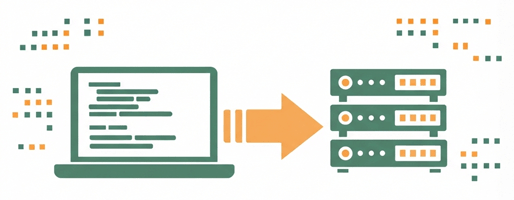
Infrastructure as Code – What is it? While classic setups are done manually, IaC allows the control of networks and servers through code. This forms the foundation for modern DevOps workflows and a scalable Industry 4.0.
YAML – What is it? Within DevOps processes, YAML serves as the central language for configuration files to define pipelines and infrastructure parameters in a version-controllable format that is readable for both humans and machines.
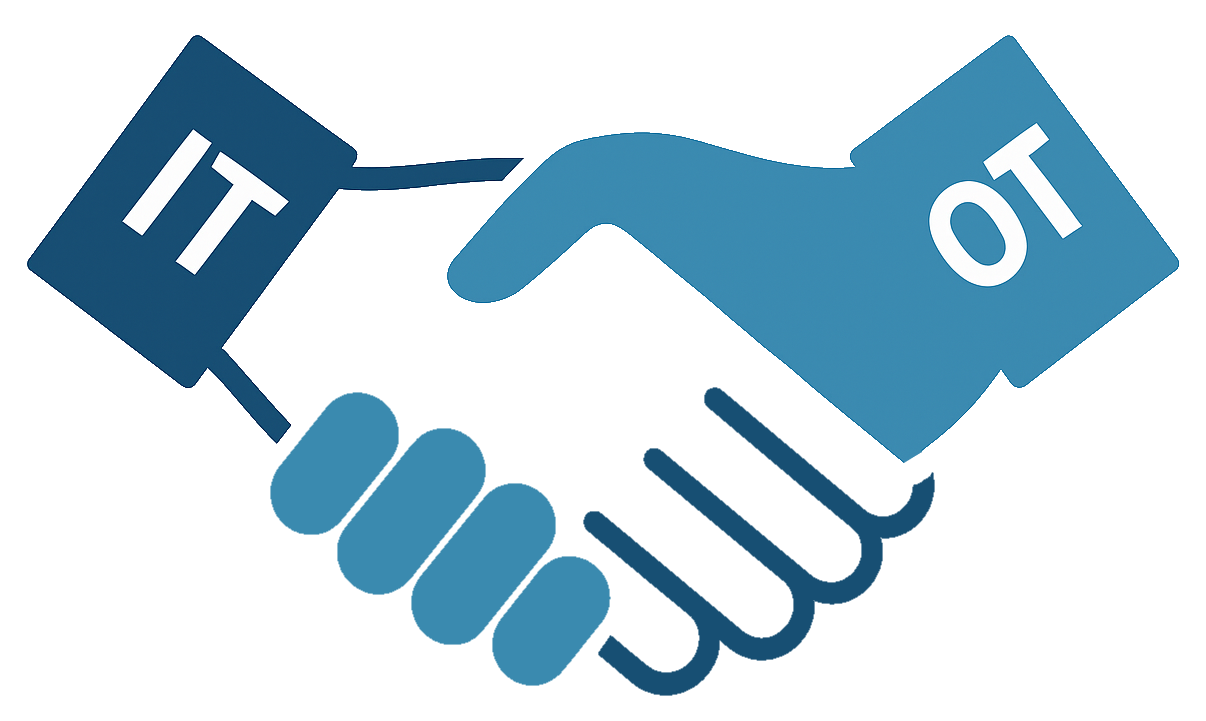
IT/OT Integration – What is it? DevOps bridges the gap between IT and OT by using methods of modern software development to automate data exchange between the production level and IT systems in a secure, fast, and reproducible manner.
More interesting articles on the topics of Industry 4.0, Cloud, Technology, Alerting, and practical application examples as well as case studies can be found in our Knowledge Base.