
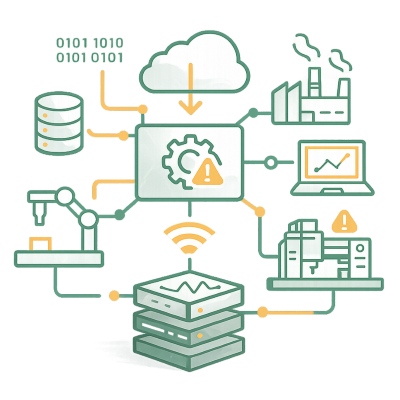
Predictive Maintenance (PdM) is a data-driven process technology for the proactive maintenance of industrial equipment and machinery. The method uses condition and operational data from sensors and IT systems, often in real time, as well as machine learning algorithms to determine the optimal time for maintenance interventions before a defect occurs. In contrast to rigid maintenance intervals, this approach is based on the actual condition of the equipment and aims to precisely determine the Remaining Useful Life (RUL).
1. Introduction
In modern production environments, unplanned machine failures cause significant costs through downtime, production loss, and emergency repairs. At the same time, rigid maintenance schedules lead to unnecessary interventions on fully functional equipment and tie up resources. Predictive Maintenance connects real-time data from Operational Technology (OT) with analytical methods at the IT level to optimize maintenance cycles. The challenge lies in reliable data acquisition, the integration of heterogeneous systems, and the practical implementation of the insights gained during ongoing operations.
2. Why Predictive Maintenance Matters
Costs of Unplanned Failures
An unplanned production stoppage costs, depending on the industry, between several thousand and several hundred thousand euros per hour. Emergency operations cause costs three to five times higher than planned maintenance due to overtime and rush surcharges for spare parts.
Inefficiency of Fixed Maintenance Intervals
Preventive maintenance according to a fixed schedule ignores the actual condition of the equipment. Components are replaced even though they are still functional. Other parts fail before the scheduled interval. This waste causes unnecessary material and personnel costs.
Complexity of Modern Equipment
Production plants consist of hundreds of interconnected components from various manufacturers. The condition of individual parts is difficult to assess without continuous monitoring. Manual inspections are time-consuming and error-prone.
Safety Risks
Sudden mechanical failures can create dangerous situations for personnel and the environment, especially in industries such as chemicals or oil.
3. How Predictive Maintenance Works
Data Acquisition
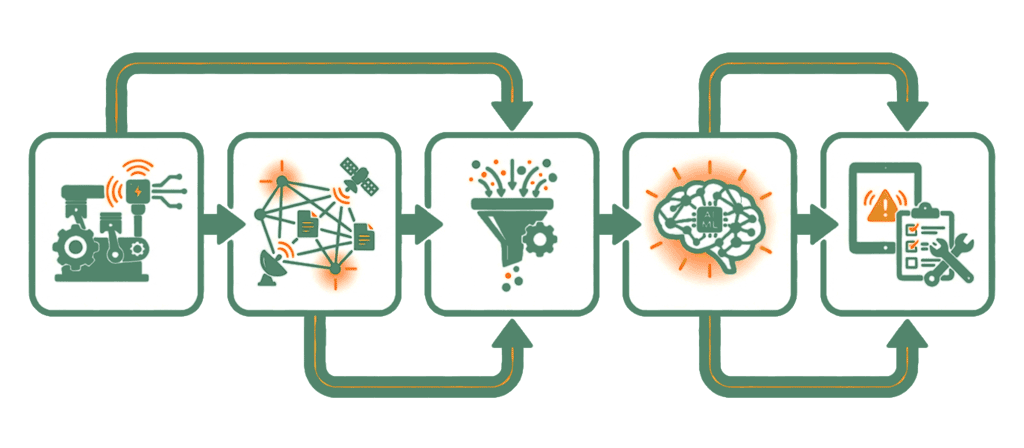
Sensors continuously capture operating parameters: vibrations (via accelerometers), temperature, pressure, rotational speed, current consumption, or oil quality. The data is retrieved from the control level via fieldbuses (PROFINET, EtherNet/IP), OPC UA, Modbus, or MQTT.
Data Transmission and Integration
Raw data from the OT level is transferred via protocols to IT systems: historian databases, cloud platforms, or local analytics servers. Edge computing devices are often used to perform pre-filtering to conserve bandwidth and minimize latencies for critical alarms. Protocol differences, network separation, and differing cycle times must be taken into account.
Data Preparation
Time-series data is normalized, outliers are filtered, and missing values are handled. Feature engineering extracts relevant characteristics such as trend curves, peak values, or frequency patterns.
Analysis and Modeling
There are two fundamental approaches:
- Rule-based methods: Thresholds and limit values are defined (e.g., bearing temperature above 80 °C). Simple, transparent, but inflexible.
- Machine Learning: Algorithms such as neural networks or Random Forests learn from historical data how parameters behave before a failure. They compare the current state with learned failure patterns to detect deviations.
Hybrid approaches are also frequently used: physical models combined with statistical methods.
Action Triggering
If an impending failure is detected, the system generates warning messages or automatically creates work orders in the CMMS (Computerized Maintenance Management System). This enables the maintenance team to carry out repairs during planned production downtime.
4. Benefits of Predictive Maintenance
- Reduction of Maintenance Costs: Avoiding emergency operations and unnecessary maintenance significantly reduces overall costs.
- Increased Equipment Availability: Unplanned downtime is considerably reduced through early problem detection.
- Extended Service Life: By avoiding consequential damage, the service life of equipment is noticeably increased.
- Improved OEE: Overall equipment effectiveness increases through optimized performance and less downtime.
- Energy Efficiency: Well-maintained machines exhibit higher energy efficiency and reduce consumption.
- Planability: Maintenance windows can be aligned with production schedules.
5. Use Cases & Practice
Predictive Maintenance is particularly valuable across industries wherever failure costs are high.
Automotive Industry
Monitoring of robotic welding guns, test benches, paint shops, and conveyor systems to keep cycle rates stable. Every minute of downtime counts.
Energy Sector
Wind turbines use vibration analysis to detect gearbox damage early and plan costly offshore operations. Gas turbines and transformers are subject to extreme loads.
Logistics and Rail Transport
Monitoring of wheel sets, bearings on trains, conveyor technology, and stacker cranes. Failures block entire supply chains or cause delays.
Process Industry
Detection of leaks in pumps and valves in oil refineries or chemical plants. Failures threaten not only production, but also product quality and safety.
Manufacturing
Monitoring of machine tools, spindles, drive belts, and presses. Particularly relevant with high unit costs or tight tolerances.
6. System Integration
Predictive Maintenance requires the integration of data sources from different systems and protocols. Middleware such as the OPC Router handles protocol-independent data acquisition and routing between the OT and IT worlds:
Data Aggregation: Condition data is read directly from the PLC (via OPC UA or conventional protocols) and consolidated from various sources.
Connectivity to Analytics Platforms: Structured transfer to cloud services (Azure IoT Hub, AWS IoT Core), local MQTT brokers, or analytics servers on which AI models run. The Snowflake Plugin allows machine data to be transferred directly into the Snowflake AI Data Cloud, where it is available for extensive analyses, long-term evaluations, and the integration of ML models.
With support for the Model Context Protocol (MCP) in the OPC Router, an AI can access all data sources available in the OPC Router via a unified, standardized interface. The Router links the information, provides it in a contextualized manner, and at the same time governs which data may be passed to the AI.
Feedback into Business Processes: Maintenance recommendations are received and automatically created as service orders in ERP systems or CMMS.
Contextualization: Linking technical sensor data with master data from IT (e.g., asset IDs) to make alarms clearly identifiable for maintenance personnel.
Typical Scenarios: Writing machine data from OPC UA into time-series databases, reporting threshold exceedances via REST API to CMMS, transferring aggregated key figures to cloud platforms. The advantage lies in decoupling: analytics platforms can be replaced without touching the field level.
7. Challenges & Limitations
Data Quality
Insufficient sensors, incorrect calibration, or transmission errors lead to incorrect predictions. False alarms reduce trust; missed failures cause damage.
High Initial Costs
Investments in sensors, IT infrastructure, and software licenses can be considerable, especially for SMEs. The business case must be evaluated individually for each piece of equipment.
Skilled Labor Shortage
Experts are required who understand both mechanical processes and data analysis. Skepticism toward automated predictions requires training and transparency.
Brownfield Integration
Retrofitting older equipment with modern sensors is technically complex and often requires specialized gateways. If a machine rarely fails, there is insufficient data for ML models.
Security Aspects
The transmission of sensitive production data increases the attack surface for cyber attacks. OT/IT network separation requires additional infrastructure such as firewalls or DMZ.
8. Frequently Asked Questions about Predictive Maintenance
- What is the difference between predictive maintenance and condition monitoring?
Condition monitoring monitors the current status and indicates when limit values are exceeded. Predictive maintenance goes one step further: it predicts when a failure is likely to occur, enabling early planning.
- Do I absolutely need machine learning for predictive maintenance?
No. Rule-based approaches with threshold values and trend analyses often deliver good results. Machine learning is useful when relationships are complex and sufficient data is available.
- What sensors are required for predictive maintenance?
That depends on the machine. Typical examples include vibration sensors (bearings, drives), temperature sensors (motor, oil), current sensors (motor load), pressure sensors (hydraulics, pneumatics), and acoustic sensors (anomaly detection).
- How quickly does a predictive maintenance solution pay for itself?
The payback period varies greatly. In areas with high downtime costs (e.g., continuous processes, just-in-time production), the investment can pay for itself within months. For less critical systems, it can take years.
- How do I deal with old systems without sensors?
Retrofitting is an option, but often expensive. Alternatively, external sensors can be retrofitted (e.g., clamp-on current sensors, portable vibration meters). Sometimes predictive maintenance is only worthwhile for critical components within the old plant.
9. Conclusion
Predictive Maintenance reduces unplanned failures, lowers maintenance costs, and increases the availability of production equipment. The prerequisites are reliable data acquisition, well-thought-out integration between OT and IT, and embedding within existing maintenance processes. Success depends less on the choice of algorithm and more on a solid data foundation and seamless system integration. Modern middleware solutions such as the OPC Router simplify implementation and make Predictive Maintenance achievable even without extensive programming knowledge.
10. Technical Terms Explained
CMMS (Computerized Maintenance Management System)
Software for planning, managing, and documenting all maintenance tasks, spare parts, and work orders.
RUL (Remaining Useful Life)
Estimated remaining operating time of a component until failure or until maintenance is required.
Edge Computing
Data processing directly at the data source (e.g., gateway at the machine) to minimize response times and conserve bandwidth.
OEE (Overall Equipment Effectiveness)
Key metric for evaluating overall equipment effectiveness, calculated from availability, performance, and quality.
Anomaly Detection
AI method for identifying data points that do not correspond to the normal operating pattern.
Random Forests
Machine learning algorithm based on multiple decision trees. Each tree is trained with a random selection of training data and makes a prediction. The final decision is made by a vote of all trees.
Discover Other Topics

IT/OT Integration – What is it? Predictive Maintenance relies on the seamless connection between the production level (OT) and business systems (IT). IT/OT integration creates the technical bridge so that maintenance recommendations flow automatically into ERP or CMMS systems and machine data can be analyzed securely.
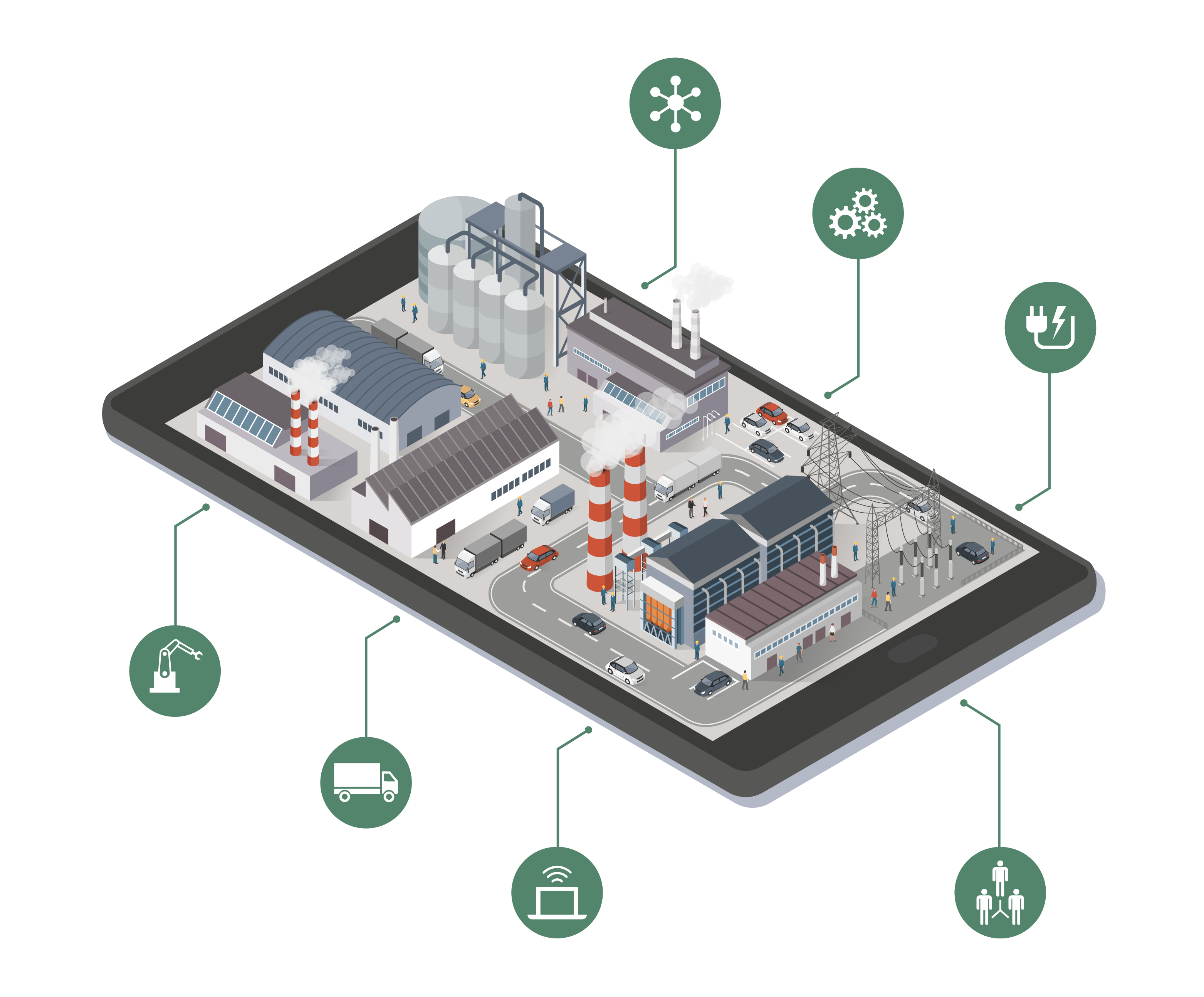
Industry 4.0 – What is it? Predictive Maintenance is a core building block of Industry 4.0. The intelligent networking of machines, data analysis, and automated processes create the foundation for predictive maintenance strategies and data-driven production optimization.

OPC UA – What is it? OPC UA is the backbone of modern Predictive Maintenance architectures. The protocol enables standardized, secure access to machine data from controllers and sensors – the foundation for reliable condition monitoring and failure prediction in Industry 4.0.
More interesting articles on the topics of Industry 4.0, Cloud, Technology, Alerting, and practical application examples as well as case studies can be found in our Knowledge Base.