
SOAP – Standardized protocol for reliable web service communication
SOAP has been an established standard for the exchange of structured data via web services for many years. SOAP really comes into its own in corporate environments, ERP systems, and industrial integration projects, offering clear contracts, robust interfaces, and maximum interoperability.
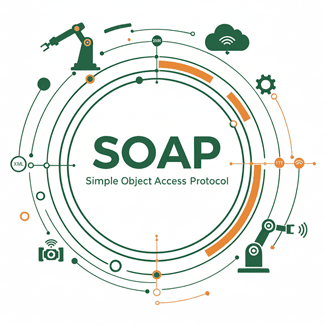
1. Introduction to SOAP
1.1 What is SOAP?
SOAP (“Simple Object Access Protocol”) is a standardized, platform- and language-independent protocol for exchanging structured messages over networks.
Key features:
• Exchange via XML-based messages
• Often transported via HTTP/HTTPS, but also SMTP, TCP, etc.
• Independent of programming language or platform
• Formal framework for functions, parameters, and returns
This makes SOAP particularly well suited for scenarios that require clearly defined, stable interfaces.
1.2 Structure of a SOAP message
A SOAP message consists of several clearly defined elements:
Envelope
The outer frame that specifies the structure and context of the message.
Header (optional)
Contains metadata such as:
• Security information
• Routing
• Transactions
Body
Contains the actual payload or function calls of the web service.
Fault (optional)
A standardized error structure for consistent error management.
1.3 Advantages of SOAP & typical use cases
SOAP offers several features that make it particularly suitable for critical business processes:
Platform and language independence
Whether Java, C#, Python, or old legacy systems—SOAP works in heterogeneous landscapes.
Standardized interface via WSDL
The WSDL description contains all details such as:
• Available functions
• Expected parameters
• Return values
High robustness and extensibility (WS standards)
SOAP supports many standards such as:
• WS-Security
• Reliable message transmission
• Routing
• Complex transaction models
Support for complex data structures
Arrays, nested data, complex types – SOAP can do much more than simple flat data.
Typical areas of application
• ERP/CRM/SCM systems with clear interface contracts
• Integrations across network or system boundaries
• Security or transaction-critical scenarios
• Function-oriented API communication
1.4 SOAP vs. REST – a brief overview
While SOAP is a strict protocol, REST describes an architectural style with flexible implementation.
| Feature | SOAP | REST |
|---|---|---|
| Type | Protocol | Architecture style |
| Transport | HTTP/HTTPS, SMTP, TCP … | usually HTTP/HTTPS |
| Data format | XML | JSON, XML, HTML, Text |
| API model | Function-oriented | Resource-oriented |
| Interface | WSDL (contract) | mostly documentation-based |
| Overhead | higher | lightweight |
SOAP is ideal for: stability, security, complexity
REST is ideal for: speed, simplicity, flexibility
2. SOAP in Industry & IT Integration
SOAP is widely used in classic enterprise systems such as ERP, CRM, and MES. SOAP plays a central role in Industry 4.0 projects in particular, as many established systems continue to rely on SOAP-based web services. Here, SOAP enables a reliable, long-term stable communication channel.
3. SOAP communication in OPC Router
The OPC Router integrates SOAP web services via the ERP / SOAP Web Services Plug-in without programming. The WSDL import automatically recognizes functions and configures them via drag & drop. Complex data types, nested structures, and arrays are fully supported.
Typical use cases
• ERP ↔ Production: Retrieval of recipe, material, and master data as well as feedback on quantities, batches, or consumption.
• Machine control: Transmission of approvals or commands from the ERP to machines/OT.
• System integration: Combination with OPC UA, databases, REST, SAP, MQTT, and more.
Advantages
• Use of standardized interfaces
• High reliability and clear interface agreements
• Can be flexibly combined with other protocols
• Ideal for Industry 4.0 scenarios with high data consistency requirements
• Minimal programming effort
4. When is SOAP useful – and when is it not?
Well suited when:
- existing systems provide SOAP web services
- structured function calls and complex data are required
- formal interface contracts play a role
- security and stability are more important than maximum performance
Less suitable if:
- Very lightweight, fast APIs are required (→ REST)
- Bandwidth or CPU resources are scarce
- Flexibility is more important than strict structure
5. Frequently asked questions about SOAP
- What is SOAP and what is it used for?
SOAP (Simple Object Access Protocol) is a standardized, platform- and language-independent protocol for exchanging structured messages over networks. It uses XML-based messages and is particularly suitable for scenarios with clearly defined, stable interfaces—such as in ERP systems, CRM solutions, or industrial integrations.
- What are the components of a SOAP message?
A SOAP message consists of:
- Envelope: The outer frame with structure and context
- Header (optional): Metadata such as security information, routing, or transactions
- Body: The actual payload or function calls
- Fault (optional): Standardized error structure for uniform error management
- What is the main difference between SOAP and REST?
SOAP is a strict protocol with formal interface contracts (WSDL) that is based on XML and functions in a feature-oriented manner. REST, on the other hand, is a flexible architectural style that mostly uses HTTP/HTTPS, is resource-oriented, and frequently uses JSON. SOAP is suitable for stability and security, while REST is suitable for speed and simplicity.
- What benefits does SOAP provide for companies?
SOAP offers platform and language independence, standardized interfaces via WSDL, high robustness through WS standards (e.g., WS-Security), and support for complex data structures. It is ideal for security- or transaction-critical scenarios as well as for the integration of heterogeneous system landscapes.
- When should SOAP not be used?
SOAP is less suitable when very lightweight and fast APIs are required, bandwidth or CPU resources are scarce, or flexibility is more important than strict structure. In such cases, REST is usually the better choice.
6. Conclusion & recommendation
SOAP remains an extremely robust and reliable protocol for web services – especially where clearly defined interfaces, security, and structured data are important.
With the OPC Router, SOAP can be integrated without programming and incorporated into modern industrial and IT landscapes. This makes it ideal for companies that want to efficiently connect ERP, production, and data systems.
Discover other topics

What is REST?
When it comes to connecting systems, REST (Representational State Transfer) almost always plays a key role. Especially in the context of web-enabled systems, REST is one of the leading standards for system integration.
OPC UA enables standardized access to machines, devices, and other systems in Industry 4.0, ensuring manufacturer-independent data exchange. Our Knowledge Base provides an overview of the functionality and terminology of the most important communication protocol for Industry 4.0 and the Industrial Internet of Things (IIoT).
Learn more about the advantages of automated data exchange with the OPC router at adhesive label manufacturer HERMA. Direct PLC-to-ERP communication digitally integrates pre-production, production, packaging, and maintenance. 14 machines and 35 connections between PLC controllers and ERP-SAP are intelligently linked by the middleware.
You can find more interesting articles on Industry 4.0, the cloud, technology, alerting, practical application examples, and case studies in our Knowledge Base.